


Paleotological Animations
for Natural History Museums
Designed to be exhibited alongside Sebastian Brandt’s hand-crafted physical models, these animations are brought to life through behavioral sequences. This gives visitors a deeper understanding of extinct organisms, their locomotion, ecological relationships and prehistoric ways of life.
Reconstruction models brought to life


Scientifically Based Content
By combining scientific reconstruction with cinematic visualization, these animations depict extinct organisms as living animals within their natural environments. Every movement, habitat and ecological interaction is based on interdisciplinary research - incorporating functional morphology, biomechanics, ichnology, paleoclimate studies, hydrodynamics and actualistic comparisons with modern organisms.
Complimenting Reco-Brandts physical paleontological reconstructions, the animations visualize how these extinct organisms adapted to specific ecological niches. Factors like locomotion, feeding behavior, body posture, injuries and hydrodynamic efficiency are dynamically reconstructed through the thorough analysis of fossil evidence, trackways, anatomical structures and biomechanical plausibility.
Read more here.
Example Clips
All paleontological animations are made-to-order.
Diplocaulus
Functional Morphology & Hunting Behavior
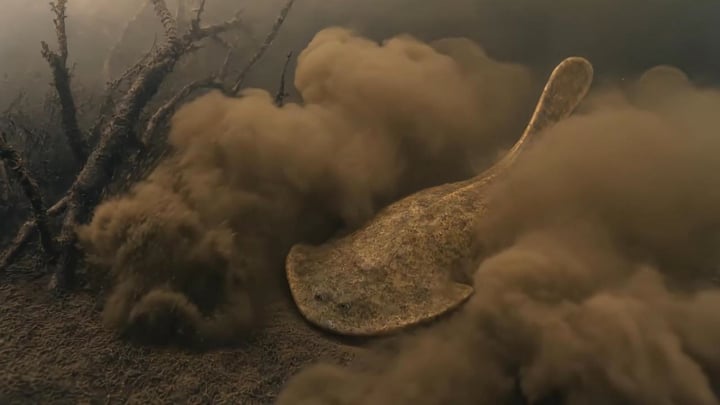
Animation of Diplocaulus in its natural habitat.
Diplocaulus was an aquatic amphibian that lived during the Late Carboniferous and Permian periods approximately 300–270 million years ago in freshwater river and swamp systems of present-day North America and Europe. The animal is best known for its distinctive boomerang-shaped skull, whose function was debated for more than a century.
Research Methodology
The reconstruction of Diplocaulus integrates functional morphology, ichnology, biomechanics, hydrodynamics, paleoecology, and actualistic comparison with modern aquatic organisms to understand the animal within its ecological and functional context. A central aspect of the reconstruction involved the reevaluation of the feeding trace Hermunduichnus fornicatus, which indicates a specialized suction-feeding strategy. The broad flattened skull is reconstructed as a functional hunting structure that generated negative pressure against soft sediment to force small prey organisms out of the substrate.
Hydrodynamic analysis and biomechanical testing further indicate that the skull functioned as a stabilizing surface during benthic locomotion close to the ground. The three-dimensional physical model helped to evaluate anatomical proportions, movement mechanics, and body volume, allowing the reconstruction of Diplocaulus as a specialized bottom-dwelling predator adapted to Permian freshwater ecosystems. More on methodology here.


Digital images of Diplocaulus in permian pond.


Physical Reconstruction Model
Photography: Physical paleontological reconstruction of Diplocaulus made by Sebastian Brandt
The resulting scientific conclusions are translated into highly detailed physical reconstruction models, in which functional morphology, biomechanics, ecological adaptation and inferred behavior are translated into a three-dimensional representation of the living organism. See physical model here.
Germanonautilus bidorsatus hunting Ceratites evolutus
Functional Morphology & Behavior
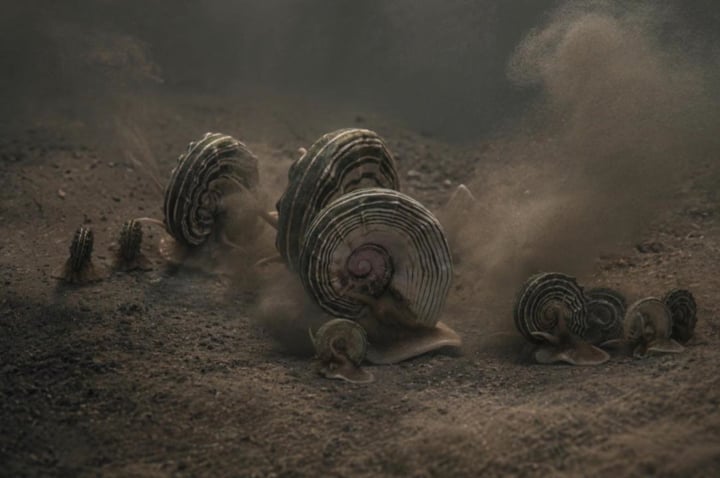
Ceratite herd being hunted by Germanonautilus
Ceratites evolutus was a widespread, low-motility ammonoid that existed in large, herd-like benthic generation communities throughout the isolated Middle Triassic Muschelkalk Sea. Germanonautilus bidorsatus occupied the same marine basin as a highly mobile, solitary nautilid that operated as an opportunistic predator.
Research Methodology
Functional morphology and quantitative taphonomy were combined to reconstruct the paleoecology and trophic interactions of Ceratites evolutus and Germanonautilus bidorsatus. By evaluating the mechanical capabilities of the oral apparatuses alongside population-wide statistical research of expansive fossil horizons like the Kronach Ceratites Plate, the model establishes that the paired carbonaceous elements of Ceratites were morphologically identical, mathematically excluding a shearing beak function in favor of sediment-scooping mechanics. The high-pressure durophagous capability of the robust, mineralized jaw elements (Rhyncholites and Conchorhynchus) confirm the active predatory role of Germanonautilus. This macroecological synthesis maps the active predator-prey dynamics of the solitary nautilid hunting these low-motility herds, using the absence of pelagic hydrodynamic indicators and high-density monospecific fossil clusters to reconstruct Ceratites as localized benthic grazers. The research is based on the paleontological findings of Siegfried Rein and Sebastian Brandt. More on Ceratites here.


Digital images of Ceratites evolutus and Germanonautilus bidorsatus on Triassic sea floor.


Physical Reconstruction Model
Photograph: Physical paleontological reconstruction of Germanonautilus bidorsatus and biospecies Ceratites nodosus. The latter represented by the distinct chronospecies Ceratites evolutus and Ceratites spinosus. Made by Sebastian Brandt
The resulting scientific conclusions are translated into highly detailed physical reconstruction models, in which functional morphology, biomechanics, ecological adaptation and inferred behavior are translated into a three-dimensional representation of the living organism. See physical model here.
Dimetrodon teutonis
Functional Morphology & Hunting Behavior
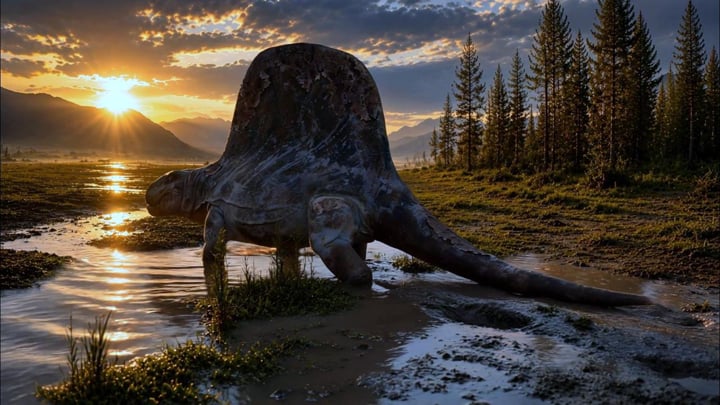
Dimetrodon teutonis in its natural habitat
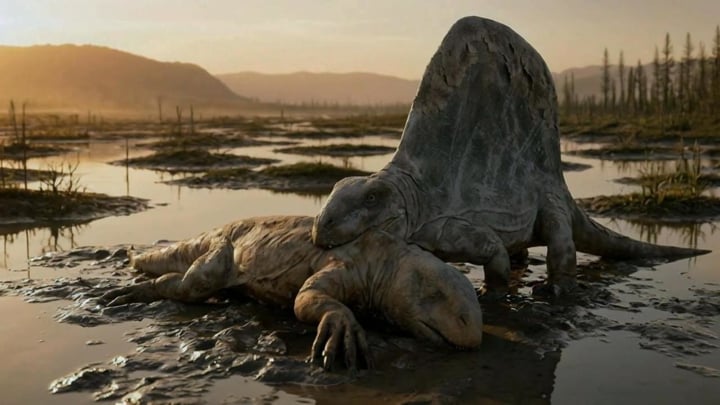
Dimetrodon was a genus of apex predatory synapsids (mammal-like reptiles) that lived during the Early Permian period, roughly 295 to 272 million years ago. Its most distinctive feature was a large dorsal creast on its back, which scientists believe was used for thermal regulation or mating displays.
Research Methodology
The reconstruction of Dimetrodon teutonis utilizes Bromacker fossil site data to translate skeletal fragments into a verified 3D volume based on actualistic locomotion and functional anatomy. This methodology integrates regional morphological scaling from German holotypes, specific dental analysis and verified, microscopic skin texturing over a plausible sprawling posture. Following these biomechanical conclusions, the data is materialized into a physical, life-sized model by meticulously hand-sculpting the animal to ensure the anatomy is cohesive without structural conflict. More on methodology here.


Digital images of Dimetrodon in Permian swamp environment.


Physical Reconstruction Model
Photograph: Physical paleontological reconstruction of Dimetrodon made by Sebastian Brandt
The resulting scientific conclusions are translated into highly detailed physical reconstruction models, in which functional morphology, biomechanics, ecological adaptation and inferred behavior are translated into a three-dimensional representation of the living organism. See reconstruction model here.
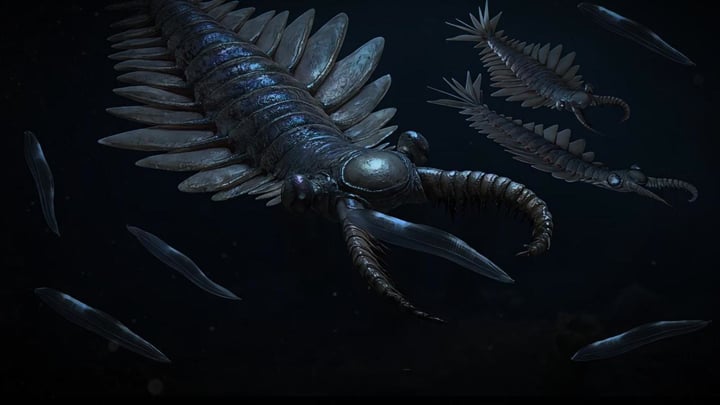
Anomalocaris
Functional Morphology & Hunting Behavior
Anomalocaris in its natural habitat
Anomalocaris canadensis was a highly efficient marine apex predator that lived during the Cambrian period 500 million years ago. Reaching lengths of up to one meter, it had large compound eyes, complex frontal appendages and a circular, hook-lined mouth to hunt and consume smaller prey.
Reconstruction Methodology
The reconstruction of Anomalocaris is based on a functional-morphological approach combining fossil anatomy, biomechanics, hydrodynamics, comparative zoology and energetic efficiency analysis. Instead of treating fossil parts as isolated structures, the model examined how all anatomical elements functioned together within a living animal.
The reconstruction integrated overlapping swimming paddles, protected internal gill chambers linked to paddle motion for active respiration, coordinated frontal appendages for prey capture and transport and hydrodynamically efficient body proportions. The swimming paddles were reconstructed as a continuous wave-like propulsion system to maximize thrust while minimizing energy loss. The frontal appendages were positioned diagonally inward to alternately grip and transfer prey toward the oral cone in a coordinated feeding sequence. Comparisons with modern arthropods and cephalopods helped test the biological plausibility of movement, feeding behavior and respiratory mechanics. More on methodology here.


Digital images of Anomalocaris in various scenarios.


Physical Reconstruction Model
Photograph: Physical paleontological reconstruction of Anomalocaris made by Sebastian Brandt
The resulting scientific conclusions are translated into highly detailed physical reconstruction models, in which functional morphology, biomechanics, ecological adaptation and inferred behavior are translated into a three-dimensional representation of the living organism. See physical model here.