


The Diplocaulus Code: How a “Boomerang” Became a Hunting Tool
Diplocaulus, a Permian amphibian with its iconic boomerang-shaped skull, has long puzzled scientists. While earlier theories suggested hydrodynamic or defensive functions, new analysis of rare trace fossils (Hermundurichnus fornicatus) from Thuringia reveals a different picture. These exceptionally preserved impressions show detailed skin patterns and movement traces, indicating that the animal used rapid vertical head movements to generate suction in soft sediment. This allowed it to extract hidden prey such as small crustaceans and larvae - effectively functioning like a biological suction pump. Based on this evidence, a new reconstruction presents Diplocaulus as a highly specialized, flat-bodied predator adapted to shallow Permian waters.
PREHISTORIC AGE
Sebastian Brandt
4 min read
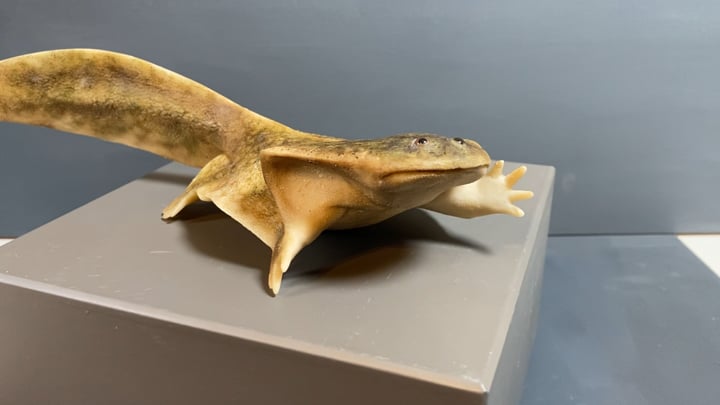
360° view of a paleontological reconstruction of Diplocaulus, based on the latest scientific standards.
Diplocaulus - functional morphology study
Paleontological reconstruction made-to-order


Diplocaulus reconstruction made by Sebastian Brandt; based on the latest scientific research 2026.
A new perspective on one of the most enigmatic animals of the Permian
In paleontology, some organisms appear almost alien. Diplocaulus is a striking example: an amphibian with a skull shaped like a boomerang. What was the function of this bizarre morphology? Sebastian Brandt (Atelier Reco-Brandt) has revisited this question and presents a compelling new interpretation.


Humid savanna with Dimetrodon and Parasaurus geinitzi, paleontological reconstruction by Sebastian Brandt
A journey 290 million years back in time
To understand this animal, we must first consider its environment. Around 290 million years ago, Earth was dominated by a single supercontinent: Pangaea. The hypercontinental climate led to extreme daily temperature fluctuations and episodic megamonsoon events, causing extensive flooding.
Diplocaulus inhabited swampy landscapes with numerous shallow water bodies. It was highly adapted to these conditions, showing a remarkable degree of functional and morphological specialization.


View of planet Earth showing the supercontinent Pangaea
The traditional hypothesis: a hydrodynamic structure?
For decades, the unusual skull was interpreted as having hydrodynamic functions, comparable to the wings of an aircraft, potentially generating lift while swimming. Other hypotheses suggested a defensive function, with the broad head making the animal difficult for predators to swallow.


Outdated sketches of various artists:


Outdated sketch of Diplocaulus
The skeleton: a bizarre masterpiece of nature
In many respects, the postcranial skeleton resembles that of modern salamanders. What makes Diplocaulus appear so unusual is its flattened, delicate body and, above all, its distinctive skull, which could reach widths of up to 30 cm. J
uveniles possessed relatively rounded, salamander-like skulls. With maturity, the lateral extensions expanded dramatically. The small eyes and comparatively small mouth further indicate a highly specialized mode of life.


Diplocaulus skeleton with its iconic boomerang-shaped skull
The breakthrough: trace fossils from the Thuringian Forest
The key to resolving the mystery did not lie in skeletal remains, but in subtle trace fossils discovered in the 1970s in Thuringia, Germany. Near Rotterode, unusual resting traces (Hermundurichnus fornicatus) were identified, initially puzzling in their interpretation.
In 1980, Th. Martens, J. Schneider, R. Werneburg and colleagues recognized these as resting traces of diplocaulids. These fossils remain the first and only evidence of their kind worldwide. They preserve highly detailed skin impressions within fine-grained sediment of a small water body, including clear evidence of scalation and complex movement patterns.
In 2014, Sebastian Brandt reanalyzed these traces and identified several key features. The skull was likely integrated into a disc-shaped body outline via functional soft tissue structures, referred to as “cervical flaps.” This membranous margin probably extended across the entire body, including the limbs. The resulting body form would have been broad and extremely flattened, comparable to that of modern flatfish. The traces also show vertical movements of the head, arcuate scratch marks produced by a fin-edged tail, and impressions of the forelimb digits.
Overall, the evidence suggests an initial circular movement of the body, followed by a forceful, oblique pressing of the anterior body into the substrate, and finally rapid, repeated vertical movements of the boomerang-shaped skull.


Diplocaulus sceletton with graphic sketch
A new interpretation: the boomerang as a suction device
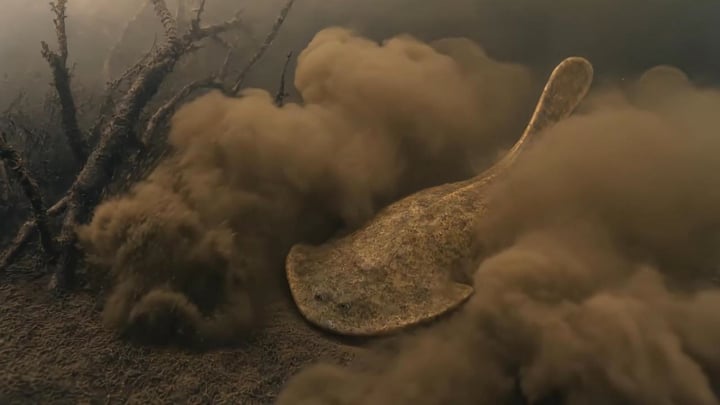
Analysis of the traces reveals a striking behavior. The animal performed clawing movements while rapidly moving its broadened head—and thus the entire body margin—up and down in a vertical motion.
This raises a crucial question: what was the purpose?
Brandt interprets Hermundurichnus fornicatus as a feeding trace of diplocaulids. Through this movement pattern, the animal was able to generate localized negative pressure and transfer it into the soft sediment of the pond floor. This mechanism allowed Diplocaulus to effectively extract buried prey such as small crustaceans, insect larvae, and mollusks from the substrate—functionally comparable to a suction pump.
The new theory: the boomerang as a suction pump




Diplocaulus paleontological reconstruction by Sebastian Brandt
Reconstruction at the highest level
To make this theory tangible, Atelier Reco-Brandt developed a new, scientifically grounded reconstruction that integrates both skeletal data and the insights derived from Hermundurichnus fornicatus.
This model presents Diplocaulus with unprecedented realism—as a highly specialized predator of Permian aquatic environments. The reconstruction is currently on display at the Natural History Museum of St. Gallen. Visitors are warmly invited to experience it in person.
Interested in a bespoke, museum-quality Diplocaulus?
With over 15 years of experience in scientifically accurate model making, Reco-Brandt specializes in creating highly detailed paleontological reconstructions for researchers, institutions, and private collectors. With our work being exhibited in renowned Natural History Museums worldwide each piece is custom-made and crafted with scientific precision.
Request a quotation here:


Diplocaulus paleontological reconstruction in exhibition setting.