


Ceratites and the Benthic Revolution of the Muschelkalk Sea
Blog post description.This article is based on the research and population analyses conducted by paleontologists Siegfried Rein and Sebastian Brandt on Middle Triassic ceratitid ammonoids from the Germanic Muschelkalk Sea. Using more than 11,000 examined specimens, the study reconstructs one of the most complete evolutionary lineages of the Mesozoic Era and fundamentally challenges the traditional view of ammonoids as Nautilus-like floating predators. Pathological shell structures, regenerative healing patterns, and secondary shell formations demonstrate that ceratites possessed a completely different soft-body organization and likely lived as low-motility vagile-benthic animals on muddy seafloors. The research further suggests that ceratites may have formed large herd-like communities and fed as sediment grazers rather than active hunters, while the chambered shell may have functioned partly as a metabolic support organ instead of a purely hydrostatic buoyancy device.
CERATITEN
Sebastian Brandt
12 min read


This article is based on the research and population analyses conducted by paleontologists Siegfried Rein and Sebastian Brandt on the Middle Triassic ceratitid ammonoids of the Germanic Muschelkalk Sea. The essence of this research was published by Siegfried Rein here:
Zur Biologie der Ceratiten der spinosus-Zone – Ergebnisse einer Populationsanalyse: Teil I , Teil II , Teil III
During the Middle Triassic, approximately 238 million years ago, the isolated Muschelkalk Sea of Central Europe became home to one of the most extraordinary and best documented evolutionary lineages of the entire Mesozoic Era: the ceratitid ammonoids surrounding Ceratites nodosus and related chronospecies.
More than 11,000 scientifically examined specimens document a continuous evolutionary sequence spanning roughly four million years. This lineage can be subdivided into twelve clearly distinguishable chronospecies, making it one of the most complete evolutionary case studies known from the Mesozoic fossil record. A prominent field example demonstrating how these early populations are biostratigraphically recovered is documented in the TRIASSIC Retrospective: Unique Insights into the flexuosus Zone of Geilsdorf.
Yet the true scientific importance of these animals extends far beyond their evolutionary continuity. Detailed pathological and functional-morphological analyses reveal that ceratites were fundamentally different from the modern Nautilus model traditionally used to reconstruct ammonoid biology.
The fossil evidence increasingly suggests that these animals were not active pelagic floaters. Instead, they appear to have been highly specialized vagile-benthic cephalopods adapted to life directly above soft muddy seafloors within the restricted Muschelkalk basin.
The Muschelkalk Sea: An Isolated Evolutionary System
The Muschelkalk Sea formed a shallow epicontinental basin covering large parts of Central Europe during the Middle Triassic. Restricted circulation, fine-grained sedimentation, and extensive muddy seafloors created environmental conditions very different from open marine oceanic systems.
Within this isolated ecosystem, ceratitid ammonoids evolved into highly abundant and ecologically specialized organisms. Their enormous population density made them a dominant component of the food chain within the Muschelkalk basin.
At the same time, their fossil preservation provides an unparalleled opportunity to reconstruct the biology of an extinct cephalopod group.
Evolutionary Divergence Between Nautilids and Ammonoids
Nautilids and ammonoids separated evolutionarily more than 400 million years ago during the Early Devonian. Although both groups possessed externally chambered shells, their anatomical organization and biology diverged fundamentally.
Nautilids followed a conservative k-strategy involving slow growth, low reproductive output, and solitary predatory behavior. Ammonoids appear to have followed a highly opportunistic r-strategy characterized by rapid reproduction, enormous population densities, and accelerated evolutionary turnover.
The traditional assumption that ammonoids functioned biologically like modern Nautilus has dominated paleontology for decades. However, the pathological evidence preserved in Muschelkalk ceratites increasingly contradicts this interpretation.
As Siegfried Rein concluded:
“The ceratite soft body possessed no meaningful morphological or biological similarity to Nautilus.”
Fundamental Anatomical Differences Between Ceratites and Nautilus
Ceratites nodosus and the Benthic Revolution of the Muschelkalk Sea
Evolution, Ecology, and Feeding Strategies of Middle Triassic Ceratitid Ammonoids


The shell architecture of ceratites differed profoundly from that of Nautilus.
In Nautilus, the mantle attaches only locally to the shell interior, allowing the animal to retract deeply into the body chamber. The shell itself is not a completely closed spiral tube but develops through attachment of the shell wall onto previous whorls.
Ceratites, by contrast, possessed a fully closed spiral shell tube. Most importantly, the mantle adhered continuously to the hypostracum throughout the entire living chamber. This prevented retraction of the body into the shell and fundamentally changed the biomechanics of the organism.
Comparison of shell architecture and mantle attachment in Ceratites and modern Nautilus. Unlike Nautilus, the ceratite mantle was completely attached to the shell interior throughout the living chamber, preventing retraction of the soft body into the shell and indicating a fundamentally different biomechanical organization. Adapted after Rein (2005).


The shell architecture of ceratites differed profoundly from that of Nautilus.
In Nautilus, the mantle attaches only locally to the shell interior, allowing the animal to retract deeply into the body chamber. The shell itself is not a completely closed spiral tube but develops through attachment of the shell wall onto previous whorls.
Ceratites, by contrast, possessed a fully closed spiral shell tube. Most importantly, the mantle adhered continuously to the hypostracum throughout the entire living chamber. This prevented retraction of the body into the shell and fundamentally changed the biomechanics of the organism.
The siphuncle also differed strongly:
Nautilus possesses a centrally positioned siphuncle.
Ceratites possessed a marginal siphuncle running along the shell edge.
The septa themselves also differed profoundly:
Nautiloid septa are relatively simple and regularly spaced.
Ceratite septa exhibit highly irregular spacing patterns and complex morphologies.
These differences become critically important when reconstructing locomotion, buoyancy, physiology, and regeneration.
Regenerative Pathology as a Window Into Soft-Body Biology
One of the most remarkable aspects of the Muschelkalk ceratites is the enormous quantity of preserved pathological specimens.
Approximately 26% of examined individuals survived unsuccessful predator attacks during their lifetime. These injuries preserved direct evidence of regenerative processes within the soft body and mantle tissues.
Because ceratite steinkerns preserve impressions of the shell interior, they effectively record the behavior of the mantle epithelium during healing. This allows indirect reconstruction of soft-tissue organization in animals whose soft bodies are otherwise completely unknown.
Shell Fractures and Mantle Adhesion
The markedly different geometry of the shell opening and body chamber reflects major differences in soft-body organization, musculature, and biomechanical function between ammonoids and nautiloids. Adapted after Rein (2005).
Some of the most important evidence comes from massive shell fractures that the animals survived.
In many specimens, enormous portions of the living chamber were crushed, displaced, or collapsed by predator attacks. Yet the deformed shell fragments remained attached to the mantle during regeneration. In some cases, up to 80% of the living chamber was affected while the animal survived for several additional septa.
These regenerative patterns are only explainable if the mantle adhered continuously to the shell interior throughout the entire living chamber. Such injuries would be catastrophic and physiologically irreparable in modern Nautilus. This represents one of the strongest arguments that ceratites possessed a fundamentally different soft-body organization.
Massively regenerated shell fractures in Ceratites spinosus demonstrate extraordinary regenerative capabilities after predator attacks. Some individuals survived deformation of up to 80% of the living chamber, providing strong evidence for continuous mantle attachment and a soft-body organization fundamentally different from modern nautiloids. Adapted after Rein (2005).


After traumatic detachment of parts of the mantle epithelium from the shell interior, the animal secreted new internal shell layers beneath the original shell wall. These structures demonstrate that large portions of the mantle remained biologically active and capable of shell secretion throughout the shell interior.
Secondary Shell Formation: Forma Conclusa
One of the most extraordinary pathological structures in ceratites is the formation of secondary internal shells known as forma conclusa. These structures formed when parts of the mantle temporarily detached from the shell interior during traumatic stress and subsequently secreted new shell layers beneath the original shell wall.
The process demonstrates several critical biological properties:
complete mantle attachment,
large-scale mantle mobility,
coordinated regenerative secretion,
and extraordinary physiological tolerance to severe trauma.
Secondary shell structures could extend across large portions of the living chamber and even into the phragmocone. Their existence provides direct evidence that the entire mantle epithelium remained biologically active and capable of shell secretion throughout the shell interior.


C. spinosus “E”, Isseroda, size = 10.7 cm, forma conclusa, NME no. 94474. Ventral and lateral views of a Ceratites spinosus specimen showing unilateral secondary shell formation extending across the living chamber and phragmocone. The markings indicate the positions of the polished cross-sections.


C. spinosus “E”, Isseroda, size = 10.7 cm, forma conclusa, NME no. 94474. Series of polished cross-sections through the shell wall demonstrating the internal structure and thickness of secondary shell deposits within the regenerated shell area.


C. spinosus “E”, Isseroda, size = 10 cm, forma conclusa, NME no. 95023, development of secondary shell formation over 110° of the living chamber, extending laterally and ventrally on both sides without conellae.


C. spinosus “E”, Isseroda, size = 9.4 cm, forma conclusa, NME no. 95003, development of secondary shell formation over 160° of the shell, extending laterally and ventrally on both sides with conellae.


C. evolutus, Legefeld, NME No. 93070a, multiple pathological secondary shell formations (forma conclusa) in polished section with abundant conellae-forming substance.
Organic Membranes and the Function of the Phragmocone
Perhaps the most revolutionary conclusion emerging from Rein’s work concerns the function of the phragmocone itself. Traditional paleontological interpretations treated the ammonoid phragmocone as a hydrostatic buoyancy apparatus analogous to that of Nautilus. According to this model, gas-filled chambers allowed the animal to maintain neutral buoyancy in open water. However, pathological specimens reveal a very different picture.
Many ceratites developed temporary organic intracameral membranes and abnormal siphuncular structures during healing processes. These structures appear only under pathological conditions and are associated with regenerative stress responses. Rather than supporting buoyancy, these organic membranes likely functioned physiologically within fluid-filled chambers.
Rein therefore proposed a radical reinterpretation:
the phragmocone may have functioned partly as a metabolic support organ rather than primarily as a hydrostatic flotation apparatus. This interpretation fundamentally challenges the traditional pelagic ammonoid model.


Organic intracameral membranes and enlarged siphuncular structures within the phragmocone of Ceratites. These temporary pathological structures likely formed during regenerative healing processes and may have supported metabolic exchange within the shell chambers. The findings challenge the traditional interpretation of the ammonoid phragmocone as a purely hydrostatic buoyancy apparatus.
Why Ceratites Were Not Pelagic Floaters
Based on Zur Biologie der Ceratiten der spinosus-Zone – Ergebnisse einer Populationsanalyse: Teil III
Multiple independent lines of evidence argue against a permanently free-floating lifestyle. Comprehensive population analyses of anomalous shell formations reveal that these fossil cephalopods lacked the basic physiological and morphological traits found in modern pelagic floaters like Nautilus (p. 1). Instead, a detailed look at their skeletal architecture and paleopathology confirms that their unique biology was perfectly tailored for continuous interaction with the sea floor (pp. 1, 21).
1. Irregular Septal Construction
Ceratites show highly irregular septal spacing and pathological septal deformation. Such irregularity would be incompatible with a precisely balanced hydrostatic flotation system. (pp. 19-20).
2. Additional Organic Structures Increased Weight
Organic intracameral membranes and secondary shell structures would have increased body weight substantially, making stable neutral buoyancy increasingly improbable. Pathological reactions frequently forced Ceratites to secrete vast amounts of heavy, organic conchiolin material inside their shells (pp. 11, 14). These massive secretions formed secondary shells (forma conclusa) and multi-layered internal membranes that significantly added to the animal's total mass (pp. 8, 14). This added ballast would mathematically destroy the delicate equilibrium required for neutral buoyancy, making a free-floating state physically impossible (pp. 18-19).
3. Pathological Recovery in Fluid-Filled Chambers
The temporary organic membranes appear best suited for function within liquid-filled chambers associated with physiological recovery rather than gas-regulated buoyancy control. Internal organic membranes appeared only temporarily during the animal's life, rarely spanning more than five consecutive chambers (pp. 15, 19). These structures are directly linked to pathological healing processes and worked in tandem with abnormally enlarged siphuncular tubes (p. 15). Because these membranes functioned strictly within fluid-filled spaces to boost metabolism during recovery, the phragmocone cannot be viewed as a gas-regulated buoyancy apparatus (pp. 1, 20).
4. Population Ecology
Mass occurrence assemblages strongly suggest benthic generation communities rather than dispersed pelagic predators. Massive fossil accumulations of identical jaw elements provide crucial insight into the true population dynamics of these cephalopods (p. 21). The highly consistent age distribution found within these localized fossil "pavements" documents that different generations lived compactly together (p. 21). This highly social generation-community structure strongly reflects a bottom-dwelling lifestyle rather than that of solitary, dispersed pelagic predators (p. 21).
5. Adaptation to Muddy Substrates
The entire ecological context of the Muschelkalk fauna indicates adaptation to soft sedimentary environments. The soft sedimentary environments of the Upper Muschelkalk sea required specialized anatomical adaptations for bottom-dwelling organisms (pp. 1, 21). Ceratites achieved physical stability on these soft muds because their mantle epithelium was completely attached to the body chamber, preventing the body from slipping inside (pp. 1, 21). This benthic lifestyle on soft muds is further proven by adult Ceratites found with their undersides heavily encrusted by the sessile bivalve Placunopsis ostracina, confirming that these animals rested heavily and permanently on the muddy seafloor without any biological mechanism or need for hydrostatic buoyancy (pp. 5, 20).
6. Extremely Low Motility
The feeding apparatus and inferred feeding behavior imply low-energy locomotion incompatible with active pelagic predation. Together, these observations strongly support a vagile-benthic lifestyle. The unique, non-biting architecture of their jaw apparatus strictly indicates that Ceratites were entirely incapable of active predation (p. 21). They relied instead on gathering low-energy nutrients directly from the soft mud, which naturally resulted in highly sluggish locomotion (p. 21). Because their 180-degree body chamber made controlled jet-propulsion swimming mechanically impossible, they were restricted to low-energy movement while maintaining constant seafloor contact (pp. 3, 21).


Comparison between the traditional reconstruction of ammonoids as actively swimming pelagic predators and the revised interpretation proposed for Muschelkalk ceratites. Morphological, pathological, and population evidence instead supports a low-motility vagile-benthic lifestyle associated with soft muddy seafloor environments.
The Kronach Ceratites Plate and the Feeding Revolution
One of the most important discoveries concerning ceratite ecology derives from the famous Kronach Ceratites Plate from the Upper Muschelkalk. For decades, carbonaceous mouth structures preserved inside ceratite shells were interpreted as predatory jaws analogous to modern cephalopod beaks.
However, detailed morphological analysis by Siegfried Rein and Sebastian Brandt revealed a paradox:
the paired jaw elements are morphologically identical. Because both structures possess the same geometry, they could not have functioned mechanically as opposing biting jaws. This forced a complete reinterpretation of ceratite feeding biology.


The “Kronach Ceratite Slab” (“KCP”) – a seafloor pavement from the Fiedler limestone quarry on Kreuzberg near Kronach/Dörfles. Lying bed of the Gänheim Bank. Transitional zone between the spinosus Zone and the enodis/posseckeri Zone. Collection of Martin Kronach (SMK).
The slab area (155 × 90 cm) contains 21 post-spinosus ceratites (C. penndorfi and C. postspinosus), together with an additional 23 isolated internal moulds and more than 800 individual “pine needle” elements originally interpreted as plant chaff, belonging to over 400 ceratites.
Photo: F. Behr.


Stratigraphic interval of the mo2 containing the fossil horizon of the “Kronach Ceratite Slab”. Fiedler limestone quarry, Kreuzberg near Kronach/Dörfles.
Underwater Grazers of the Triassic
Rather than functioning as active predators, Ceratites evolutus likely used spoon-shaped mouthparts to gather low-energy organic material directly from the sediment surface. The animals probably hovered slowly above the muddy seafloor while collecting detritus and organic matter from soft sediments.
This interpretation explains several otherwise puzzling observations:
enormous population densities,
low-energy body organization,
reduced locomotory requirements,
adaptation to muddy substrates,
and herd-like population structures.
Instead of solitary predators, ceratites may have formed immense generation communities grazing collectively across the Triassic seabed. Ecologically, they may have functioned as the underwater equivalent of grazing herd animals.
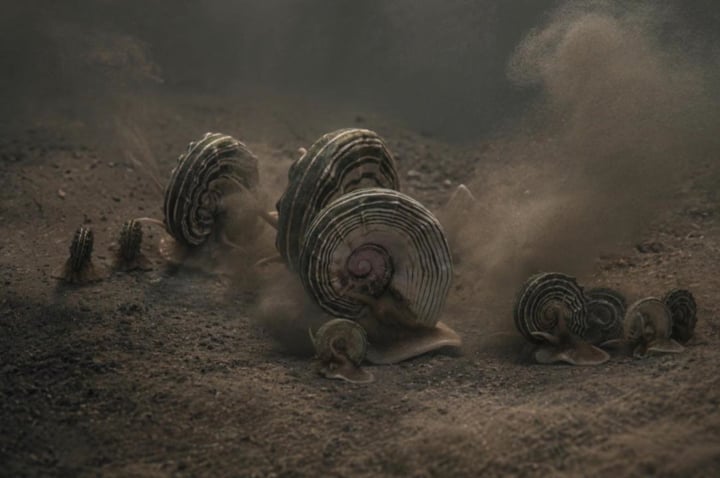
Reconstruction of herd-like populations of Ceratites evolutus moving slowly above the muddy seafloor of the Middle Triassic Muschelkalk Sea. Population structure, shell morphology, and jaw anatomy suggest a low-energy lifestyle with grazing or detritus-feeding behavior rather than active predation.
Germanonautilus bidorsatus: Predator of the Ceratite Communities
While ceratites occupied low-energy benthic niches, the nautilid Germanonautilus bidorsatus appears to have functioned as a solitary opportunistic predator within the Muschelkalk ecosystem.
This benthic cephalopod possessed specialized mineralized jaw elements:
Rhyncholites hirundo
Conchorhynchus cavirostris
These structures allowed it to crack the comparatively thin shells of juvenile ceratites and consume their soft tissues.
The ecological contrast is striking:
ceratites formed mass benthic grazing communities,
while nautilids occupied the role of solitary shell-crushing predators.
The evolutionary lineage, systematic classification, and migration patterns of these Triassic predators are further detailed in the reference study on Sturia brandti n. sp. and Sephardonautilus nov. gen. – Immigrants, Migration Routes, and Correlations in the Upper Muschelkalk (Middle Triassic).


Reconstruction of the nautilid Germanonautilus bidorsatus preying upon juvenile ceratites on the Muschelkalk seafloor. Specialized mineralized jaw elements enabled the animal to crack the thin shells of young ammonoids and consume the soft tissues inside.
Conclusion
The ceratitid ammonoids of the Muschelkalk Sea represent one of the most important paleobiological case studies of the Mesozoic Era.
More than 11,000 specimens document not only a continuous four-million-year evolutionary sequence, but also preserve direct pathological evidence of regeneration, physiology, biomechanics, and soft-body organization. The evidence increasingly contradicts the traditional image of ammonoids as pelagic nautilus-like floaters.
Instead, Muschelkalk ceratites appear to have been highly specialized vagile-benthic cephalopods:
adapted to muddy seafloors,
possessing complete mantle attachment,
capable of extraordinary regenerative responses,
living in dense social populations,
and feeding as low-energy sediment grazers.
At the same time, pathological shell structures reveal that the ceratite phragmocone may have functioned not primarily as a buoyancy device, but partly as a metabolically active physiological organ supporting recovery and survival.
These discoveries fundamentally transform our understanding of ammonoid biology and reveal a cephalopod lifestyle unlike anything alive today.


Paleontologica reconstruction of Ceratites evolutus by Sebastian Brandt. Based on shell pathology, mantle attachment structures, regenerative features, and functional morphology discussed in this study. The reconstruction depicts a benthic cephalopod adapted to life above soft muddy substrates, fundamentally different from modern pelagic cephalopods and nautiloids.
download research papers here