


Anomalocaris canadensis: A Revolution in Cambrian Paleobiology
Anomalocaris canadensis was one of the first true apex predators in Earth’s history. A new functional-morphological reconstruction by Sebastian Brandt (Reco-Brandt) reinterprets this iconic Cambrian animal not as a primitive swimmer with passive respiration, but as a highly specialized and hydrodynamically optimized hunter with an active gill-pump system directly coupled to its swimming mechanics. The reconstruction proposes internally protected respiratory chambers, overlapping wave-like swimming paddles, coordinated prey-capture appendages, and a pulsating feeding mechanism that together reveal an animal of extraordinary biological complexity and efficiency. Rather than a simple “strange shrimp,” Anomalocaris emerges as a perfectly adapted predator that dominated the Cambrian seas through advanced locomotion, active respiration, and highly specialized hunting behavior.
Sebastian Brandt
5/21/20264 min read
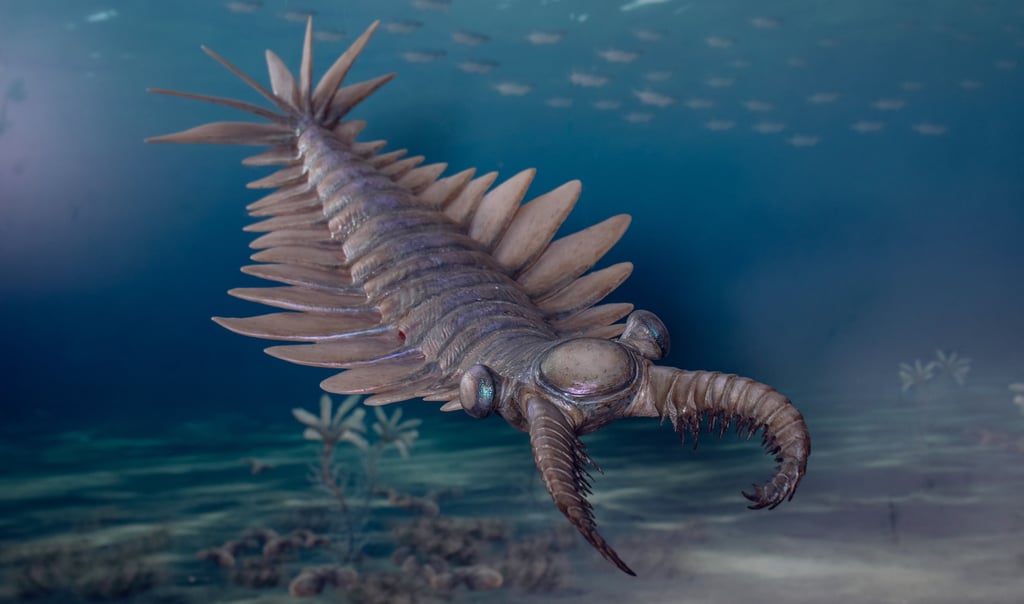

Anomalocaris canadensis: A Revolution in Cambrian Paleobiology
The Redefinition of the First Apex Predator Through Functional Morphology
The study of Anomalocaris canadensis, the “strange shrimp” of the Cambrian Period (approximately 500 million years ago), represents — perhaps more than any other case in paleontology — a history of scientific reinterpretation. For decades, the animal was known only from isolated fossil fragments that were fundamentally misidentified: the frontal appendages were interpreted as shrimp tails, while the mouth was mistaken for a jellyfish.
The current functional-morphological reconstruction by Sebastian Brandt (Reco-Brandt) significantly expands our understanding of this enigmatic animal, which reached lengths of up to one meter.
Anomalocaris paleontological reconstruction by Reco-Brandt


1. Active Respiration: The Principle of the Gill Pump
Due to the predominantly two-dimensional preservation of the fossils, direct evidence concerning the respiratory system of Anomalocaris remains limited. Earlier hypotheses often assumed passive oxygen uptake during locomotion, in which oxygen was absorbed through external gill structures directly from the surrounding water flow.
From a functional-morphological perspective, however, this interpretation is problematic in several respects. Externally exposed respiratory organs would have been highly vulnerable to injury, fouling, fungal infection, and parasitic infestation. Furthermore, under such a reconstruction, Anomalocaris would have lacked any anatomical structures capable of cleaning, regenerating, or protecting these external gills. Considering the large body size of the animal and a probable lifespan of several years, this issue becomes even more significant.
In addition, externally protruding gills would have represented a hydrodynamic disadvantage, making such a configuration unlikely in a highly specialized and efficient marine predator.
The most important innovation of the new Reco-Brandt reconstruction is the interpretation of an active respiratory system in Anomalocaris. In this model, the gill lamellae are integrated into the interior of the body, while their ventilation mechanism is directly coupled to the cascading muscular movements of the lateral swimming flaps.
Dermal Pouches and Gill Chambers
The gill lamellae are positioned dorsally as paired median structures within protected chambers embedded in the connective tissue of each trunk segment.
These chambers are covered by an elastic membrane surrounding a lateral opening positioned directly at the base of the overlapping swimming paddles, functioning analogously to a valve system.
Muscular Pumping Mechanism
During the upward movement of the swimming flaps, compression of the chamber membrane causes the chamber volume to expand. This generates negative pressure, actively drawing oxygen-rich water through the widened chamber opening and across the gill lamellae.
During the downward stroke, muscular contraction tensions the membrane and narrows the chamber. The resulting positive pressure expels oxygen-depleted water outward.
Thus, the paddle stroke of every individual trunk segment functioned not only in propulsion, but simultaneously as an active respiratory cycle.
This integration of locomotion and respiration represents a biologically plausible, hydrodynamically efficient, and energetically economical system. Given the wave-like cascading movements of the 26 interconnected swimming paddles, this interpretation suggests an extraordinarily sophisticated and highly efficient respiratory mechanism.
Regenerative Advantages
The pulsating flow of fresh water through elastic respiratory chambers would also have protected the delicate gills (septal gills) from contamination, parasites, injury, and fungal infection. Individual chambers could likely have been temporarily isolated during healing processes, representing a major evolutionary advantage for a large animal with a potentially multi-year lifespan.
2. Locomotion and Morphology
The reconstruction addresses previous gaps in knowledge through hydrodynamic considerations focused on physical and energetic efficiency — achieving maximum effect with minimal energy expenditure.
Overlapping Swimming Flaps
For the first time, the model demonstrates a strong functional overlap of the lateral swimming paddles by approximately 40–50 %. This feature is clearly visible in at least one exceptionally preserved fossil specimen.
Through this overlap, the paired swimming paddles of all trunk segments formed a continuous, wave-like pulsating unit that enabled highly efficient locomotion, comparable in principle to the swimming mechanics of stingrays or cuttlefish.
3. Predatory Behavior and Feeding Mechanics
With a body length of up to one meter, Anomalocaris stood in dramatic contrast to the often only centimeter-sized organisms of its ecosystem, such as Marrella or Pikaia.
Its head region — composed of three cephalic plates, large compound eyes, a circular oral cone, and two powerful frontal appendages — formed an exceptionally complex, sensitive, and efficient predatory apparatus.
Capture Apparatus
The two frontal grasping appendages operated in close coordination. While one appendage secured the prey, the outer spines of the opposite appendage transferred the captured organism and pushed it toward the mouth.
To achieve this functional interpretation, the frontal appendages in the new reconstruction are not arranged parallel to one another, as traditionally depicted, but diagonally inward. Only through this orientation does a mechanically plausible feeding mechanism emerge.
After prey capture, the two appendages worked alternately in a systematic sequence, using their frontal outer spines to transport prey step by step toward the oral opening.
In modern arthropods such as decapods, comparable tasks of fixation and food transfer are performed by additional specialized appendages.
Oral Cone and Pulsating Food Transport
The complex ring-shaped mouth formed the terminal component of the feeding apparatus. Prey transported toward the mouth by the frontal appendages could then be drawn into the digestive tract through cyclic protrusion and retraction of the barbed jaw plates.
Compound Eyes
Large stalked compound eyes provided Anomalocaris with nearly panoramic vision, unparalleled among most animals of its time.
Their presumed high light sensitivity also suggests the possibility of crepuscular or nocturnal hunting behavior.
Cephalic Plates
In the reconstruction, the three cephalic plates are arranged to function as stabilizing counter-supports for the muscular attachment sites of at least one major component of the feeding apparatus — including the frontal appendages, oral cone, and compound eyes — thereby maximizing functional efficiency.
Anomalocaris paleontological reconstruction by Reco-Brandt
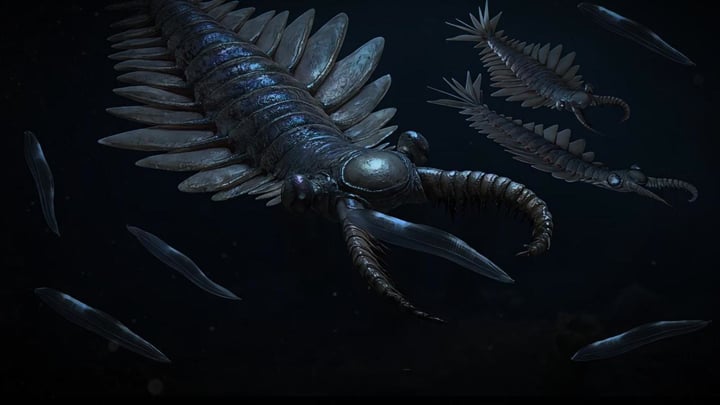
Animation of Anomalocaris by Reco-Brandt
Summary
The reconstruction by Sebastian Brandt represents a major conceptual shift in the interpretation of this Cambrian life form: away from a purely descriptive and hypothetical reconstruction toward a functionally integrated morphological model grounded in clear biological logic.
The model emphasizes protection of respiratory organs, active oxygen supply, mechanically plausible prey capture and feeding systems, and energetic efficiency.
Within this framework, Anomalocaris emerges as an active, highly specialized, and exceptionally efficient apex predator whose complex respiratory system and advanced prey-capture mechanics placed it at the top of the Cambrian marine food web.