


FAQ | Natural History Model Making & Dioramas
Questions on scientific exhibit production for natural history museums.
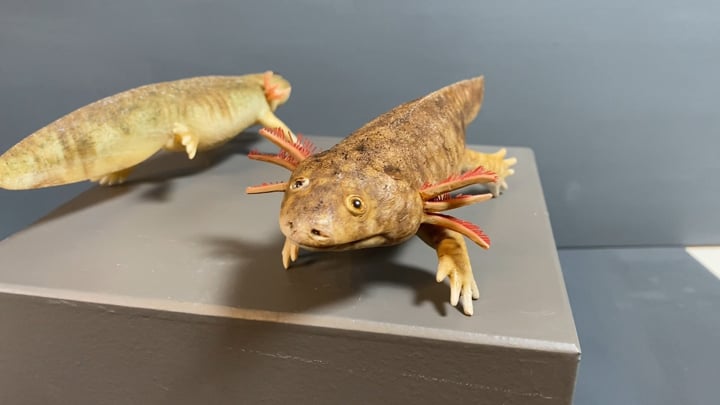
Scientific reconstructions of Anomalocaris, Diplocaulus, Eudibamus, Melanerpeton, and Proteus anguinus paleontological models made by Sebastian Brandt.
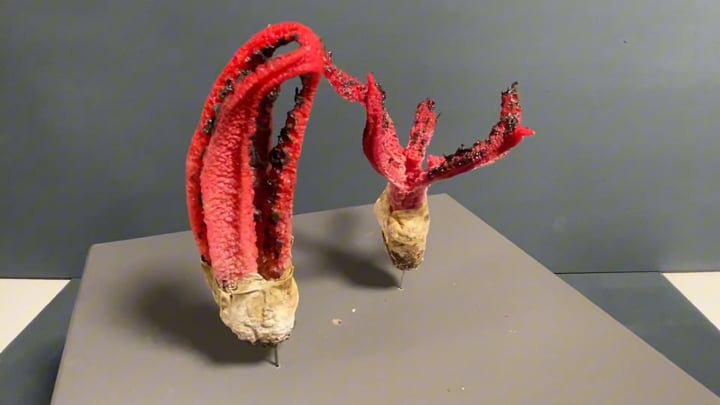
Clathrus archeri, Clavaria zollingeri, Anacamptis morio, Ophrys holiserica, Cantharellus cibarius, Sarcoscypha coccinea botanical models made by Sebastian Brandt.
Download Reco-Brandt catalogue here
Who is Reco-Brandt?
Reco-Brandt is a specialized studio dedicated to scientific model making and diorama design. We are passionate about bringing the wonders of nature to life through museum-grade reconstructions for scientific collections, natural history museums, and private collectors worldwide.
How are the natural history models and museum dioramas produced?
The creation of our scientific exhibits is a highly specialized process that merges anatomical precision with artistic perfection. Every project begins with an in-depth analysis of biological or paleontological data to guarantee a scientifically accurate reconstruction.
Our life-like botanical models and prehistoric animal models are crafted through meticulous hand-modeling and precise mold-making. For the final, true-to-life coloration, we utilize UV-resistant pigments and high-quality epoxy resins, ensuring maximum durability for daily museum use. This detail-oriented approach to diorama construction delivers world-class quality for international natural history exhibitions.
What is the cost of a custom natural history exhibit or diorama?
The pricing for our botanical replicas, paleontological reconstructions, and large-scale habitat dioramas varies depending on complexity, scale, and the required scientific research. We offer bespoke solutions—ranging from individual botanical models to comprehensive exhibition design. To meet your specific requirements and budget, we provide customized quotes for every project. Please visit our contact page for a non-binding inquiry.
How long does it take to create dioramas, botanical models, and paleontological reconstructions?
The timeline for professional model making varies depending on the project’s scope and the required scientific research. While the production of individual botanical models or smaller paleontological exhibits often takes only a few weeks, large-scale habitat reconstructions, prehistoric dioramas, and complex natural history exhibition displays can take several months. Every stage of the production process - from initial scientific research to the final coloration—is tailored to your specific schedule to guarantee the highest museum-grade quality.
Do you offer reconstructions of extinct species?
Yes, this is one of our core competencies. We specialize in paleontological reconstruction, creating life-like prehistoric animal models based on skeletal remains and fossil data. Furthermore, we offer the creation of complete diorama landscapes, depicting these animals in their original, scientifically grounded habitats.
Are the paleontological models based on specific scientific data?
Yes, we focus exclusively on research-based reconstructions and scientific models. By working in close cooperation with researchers and scientific institutions, we ensure that every diorama and botanical model is anatomically and historically accurate—covering everything from prehistoric life to modern biology.
How are life-like botanical models produced?
1. Mold Making & Casting
To capture the finest structures, such as leaf veins or trichomes (plant hairs), we utilize specialized molding techniques developed over the last 15 years. We use highly flexible casting compounds capable of reproducing details at the micrometer level. Each leaf and blossom is often molded individually to preserve the natural variability of the plant.
2. Materials Built to Last
Instead of perishable materials, we use modern high-performance polymers and epoxy resins. These materials offer:
Dimensional Stability: They do not warp or distort, even after decades.
UV Resistance: Colors remain brilliant, even under intense museum lighting.
Delicacy: They allow for the extremely thin wall thicknesses required for delicate petals.
3. Artistic Coloration
The most critical step in achieving a "living" impression is the painting process. We work with translucent layers of color and fine airbrushing techniques. Pigments are layered so that light can penetrate the material—mimicking the subsurface scattering found in real plants. The result is a model that perfectly imitates the vibrant appearance of nature.
How are life-like animal replicas produced?
Unlike industrial processes, our scientific animal replicas are created through masterful hand-modeling. Every detail—from the finest scale structures to specific anatomical features—is manually crafted by Sebastian Brandt based on rigorous scientific data.
This artistic precision allows for a life-like reconstruction that far exceeds the capabilities of purely technical procedures. For the final cast, we use high-performance polymers, which achieve their realistic appearance for natural history exhibitions through elaborate, hand-painted finishing.
How are scientific mushroom models produced?
Our mycological models are created by combining botanical precision with state-of-the-art materials science. To replicate the fragile structures of mushroom caps, gills, and mycelia, we use ultra-fine casting compounds and translucent resins. These materials allow us to imitate the specific light transparency and texture of real fungi. The result is durable mushroom replicas that, unlike real specimens, remain dimensionally stable and colorfast for decades.
How are large-scale museum dioramas produced?
Diorama construction at Reco-Brandt is a multidisciplinary process. First, we develop a concept for the habitat reconstruction based on scientific data. We then fabricate the landscape structures, integrate botanical models, and implement lighting concepts and backdrops. We use a combination of traditional sculpting techniques and modern composites to create life-like habitats that transport the viewer directly into the respective era or climate zone.
Can habitats be customized to our specific museum requirements?
Yes, we specialize in bespoke diorama construction based on individual curatorial specifications. Whether it is a paleontological reconstruction of a prehistoric site or a modern ecological habitat, we work in close collaboration with your scientists. We integrate existing specimens, adapt the dimensions precisely to your exhibition architecture, and guarantee that all materials meet strict museum conservation standards.
Do you offer taxidermy services?
No, we do not perform traditional taxidermy in-house. However, we maintain an extensive network of specialized taxidermists with whom we have collaborated for many years. This allows us to source almost any animal for your museum dioramas and integrate it seamlessly into our scientific habitat reconstructions.
How are the models and dioramas delivered?
We guarantee the safe and professional transport of our sensitive exhibits.
Within Europe: We typically deliver our museum models and dioramas personally using our own vehicles to ensure a pristine handover and, if required, on-site installation.
International Shipping: For worldwide deliveries (e.g., to the USA or the Middle East), terms are generally EXW (Ex Works) from our studio, unless otherwise agreed. In these cases, we handle the professional custom crating in sturdy transport boxes, while the client coordinates the subsequent shipping logistics.