


How Natural History Museum Dioramas Are Made and Why They Matter
Discover how natural history museum dioramas are researched, designed and handcrafted. Scientific model maker Sebastian Brandt explains how lifelike habitat reconstructions bring ecosystems, biodiversity and ecological relationships to life in museum exhibitions.
10 min read


Imagine standing in front of a small piece of meadow in a natural history museum. At first, you notice the flowering orchids, the grasses and the stones scattered across the ground. But as you move closer, an entirely different world begins to emerge. A beetle is hiding between the plants. Tiny insects are moving across the soil. What initially appeared to be a simple arrangement of vegetation gradually reveals itself as a complex network of organisms, each adapted to its particular environment.
This is what makes a well designed museum diorama so fascinating. It invites us to look closer, to discover details we might otherwise overlook and to recognise the relationships that make an ecosystem work. But creating such a scene involves far more than arranging realistic plants and animals. A scientifically accurate habitat diorama requires ecological knowledge, careful observation, artistic judgement and considerable craftsmanship. Every element must have a reason to be there, from the most prominent animal to the smallest fragment of soil.
For more than 15 years, I have specialised in creating biological models and habitat reconstructions for natural history museums. In this article, I would like to explain how museum dioramas are made, the challenges involved in their creation and why I believe they remain such valuable tools for communicating natural history.


Arabian beach diorama made by Sebastian Brandt
View catalogue here.
Calcareous grassland-, Potentilla palustre-, Pulsatilla vulgaris diorama made by Sebastian Brandt.
View catalogue here
Why Do Natural History Museums Need Dioramas?
Museums have an extraordinary responsibility. They preserve knowledge about the natural world and make it accessible to people who may never have the opportunity to experience the organisms or environments being presented. But communicating that knowledge is not always straightforward.
Consider a museum visitor standing in front of a fossil, a preserved insect or a botanical specimen. For a scientist, these objects can reveal an enormous amount of information. For someone without specialist knowledge, however, much of their significance may remain hidden. Where did this animal live? How did it move? What did it eat? Which other organisms shared its environment? A specimen alone cannot always answer these questions.
This is where natural history museum dioramas become particularly valuable. Instead of presenting an organism in isolation, a diorama places it within an ecological context. Visitors can observe how plants, animals, fungi and environmental conditions relate to one another. And they can do so without having to read a lengthy explanation before understanding what they are looking at. Of course, scientific labels, illustrations and digital media remain important. A diorama does not replace them. It offers something different: a physical encounter with a reconstructed fragment of nature. It allows people to discover information through observation.


Marsh meadow habitat (Dactylorhiza maculata, Dactylorhiza majalis, Dactylhoriza X townsendiana, Ranunculus flammula etc.) at Musée national d’histoire naturelle Luxembourg
When an Orchid Tells an Ecological Story
One of my favourite examples is the Late Spider Orchid, Ophrys holoserica. At first glance, it is simply a beautiful and rather unusual flower. But its appearance is part of an extraordinary reproductive strategy. Like other sexually deceptive orchids, Ophrys holoserica attracts particular male insects by imitating characteristics of females. The deception involves floral structures and chemical signals. When a male attempts to mate with the flower, it can inadvertently transfer pollen. It is a fascinating example of evolutionary adaptation.
Now imagine trying to communicate this process using only a preserved flower and a written description. The information may be scientifically correct, but the relationship between the organisms remains abstract. In a habitat diorama, the orchid can be presented alongside its pollinating insect and the surrounding vegetation. Suddenly, the visitor is not simply looking at a flower. They are looking at an ecological interaction. The scene provides context for the scientific explanation. And that, to me, is the real purpose of a natural history diorama: not merely to show what an organism looks like, but to help people understand how it exists within nature.


Ophrys holoserica diorama made by Reco-Brandt.
View catalogue here.
How Are Museum Dioramas Made?
People sometimes imagine that creating a museum diorama begins with modelling an animal or assembling a miniature landscape. In reality, the most important work often happens long before the first model is produced. A convincing habitat reconstruction begins with research.
Step 1: Understanding the Habitat
Before I start creating a diorama, I need to understand the environment I am trying to reconstruct. What kind of habitat is it? Where is it located? Which organisms live there? What environmental conditions shape their appearance and behaviour? A calcareous dry grassland, for example, is not simply a meadow with a few orchids growing in it. Its character is determined by its geological substrate, soil conditions, exposure, climate and the plant communities adapted to those conditions.
The vegetation is not randomly distributed. Different species occupy particular positions according to their ecological requirements. The same applies to the animals and fungi associated with the habitat. When researching a diorama, I therefore consider the geographical location, climate, season, soil composition, water availability, characteristic species and the relationships between them.
Even seemingly insignificant details matter: A plant growing in the wrong substrate, an animal represented in an implausible setting or a combination of species that would not normally occur together undermine the credibility of the entire scene. The aim is not to create the most beautiful version of a landscape. It is to create a scientifically accurate one.
Step 2: Deciding What the Diorama Should Show
Once the ecological research is complete, a different challenge begins. How do you fit an ecosystem into a limited exhibition space? Nature is extraordinarily complex. Even a few square metres of meadow can contain more organisms and ecological relationships than could reasonably be represented in a museum display. A diorama therefore requires selection. I have to decide which aspects of the habitat are essential to the scientific message and which can remain in the background. Sometimes the focus is a particular species. In other cases, it is an ecological relationship, a characteristic plant community or the structure of the habitat itself.
These decisions influence everything that follows. Which organisms should be included? Where should they be positioned? What should the visitor notice first? And what might they discover only after looking more carefully? This is where scientific interpretation and artistic composition begin to work together. A diorama is a carefully designed scene in which every element contributes to the subject being communicated.
Step 3: Creating the Biological Models
Once the composition has been established, the individual organisms can be reproduced. This is one of the most demanding parts of my work. Plants and fungi present particular challenges because their structures are often extremely delicate. Think of the thin petals of an orchid, the fine hairs covering a stem or the intricate surface of a fungal fruiting body. These details are not merely decorative. They are part of the organism's morphology and may be important for its scientific identification.
Over many years, I have developed specialised techniques that allow me to capture natural structures with exceptional precision. For botanical, original specimens serve as the basis for mould making. Their structures are reproduced in durable materials, including epoxy resin, before the individual components are processed, assembled and carefully coloured. The aim is to retain the characteristics of the original organism as faithfully as possible. This can be particularly challenging with plants because their appearance depends on many small details working together. A flower may have the correct colour and general shape, yet still look unnatural if its proportions, surface texture or orientation are wrong.
The same applies to an entire plant. Its leaves, stems, flowers and growth habit must form a convincing whole. When these models are later incorporated into a habitat, they must also interact naturally with the surrounding vegetation and substrate. A botanically accurate model that appears artificially placed can still weaken the overall impression of the diorama.
Step 4: Building the Habitat
Now comes a stage that I consider especially important, and one that is sometimes underestimated: creating the habitat itself. In many traditional museum displays, the main animal specimen receives most of the attention. The surrounding vegetation, rocks and soil are treated as background decoration. I disagree with this approach. The habitat is not decoration. It is an essential part of the scientific information being presented.
A plant does not exist independently of its soil conditions. A fungus cannot be understood entirely without considering its substrate and ecological associations. An animal's behaviour and adaptations are closely connected to the environment in which it lives. If the habitat is inaccurate, the exhibit may be visually impressive but ecologically misleading. This means that every component deserves the same level of attention. The soil, rocks, vegetation and smaller organisms must be developed with the same care as the central specimen. One poorly executed element already disturbs the credibility of an otherwise excellent reconstruction. I think of it this way: the quality of a habitat diorama is determined by its weakest ones.
Step 5: Bringing Everything Together
Once the individual models and habitat components have been prepared, they must be assembled into a coherent scene. This is where the diorama begins to acquire its final character. The placement of a plant, the direction of a branch or the position of an insect may seem like small decisions. Yet each affects how the viewer perceives the composition.
A habitat recreation is never staged but put together as it appears in nature. Natural environments don`t look perfectly arranged. Plants compete for light and space. Their stems bend, their leaves overlap and their growth patterns respond to environmental conditions. To recreate this convincingly, the composition needs a certain degree of irregularity. But there is a difference between natural complexity and visual confusion. The challenge is to preserve the apparent spontaneity of nature while guiding the viewer towards the scientific content of the display. Colour, surface texture, scale and perspective all contribute to this process.
Ideally, the finished diorama should work on several levels. From a distance, visitors recognise the overall habitat. As they approach, they begin to distinguish individual organisms. And when they look more closely, they discover details and relationships that were not immediately apparent.


Sebastian Brandt in his workshop crafting muddy landscape
Sebastian Brandt working on Arabian Spring diorama at his workshop in Germany.
Why Three Dimensions Make a Difference
There is another reason why I believe physical dioramas are so valuable in natural history museums, and it has to do with how with our primeval brain has developed. Our visual perception evolved to navigate a three dimensional environment. We judge the size, distance and proportions of objects using several sources of information, including binocular vision, perspective, movement and the changing relationships between objects as we move through space. Photographs and films can reproduce many of these visual cues, but a conventional flat image cannot provide the same spatial information as a physical object. Depending on the camera angle, lens and viewing conditions, proportions and distances can appear distorted or become difficult to judge. A photograph may show us what something looks like without fully conveying its actual size or spatial structure.
A physical diorama offers a different experience. When visitors move around a habitat reconstruction, the relationships between its elements change naturally with their viewpoint. Objects in the foreground shift against those behind them. Distances, proportions and the arrangement of organisms become easier to explore through direct observation. This is particularly important when presenting complex ecosystems, where understanding the spatial relationships between plants, animals and their environment is often just as important as recognising the individual species.
A film can show us a meadow. A photograph can capture its beauty. But a three dimensional diorama allows us to investigate its structure from different perspectives, at our own pace. That is something I consider especially valuable in scientific exhibitions. The visitor is not limited to the viewpoint selected by a photographer or filmmaker. They can choose where to look, move closer and discover relationships that may not be immediately visible.


Calcareous Grassland, Ghost Orchid, Edelweiss and Gentian Dioramas by Sebastian Brandt
View catalogue here.
Reconstructing Ecosystems That No Longer Exist
Paleontological dioramas introduce an additional challenge. Unlike reconstructions of living habitats, they represent environments that disappeared millions of years ago. Fossils provide evidence of ancient organisms, but they rarely preserve a complete picture of the ecosystems in which those organisms lived.
A fossil skeleton can reveal important anatomical characteristics. Trace fossils may provide evidence of movement and behaviour. Sedimentary deposits and geological structures offer information about ancient environmental conditions. Scientific reconstruction brings these different sources of evidence together.
From Fossil Evidence to a Prehistoric Landscape
The Permian fossil locality of Bromacker in Germany provides an example of how paleontological research can be translated into a three dimensional museum display. Fossils and associated geological evidence allow researchers to investigate animals that inhabited the region during the Permian. In a reconstructed habitat, visitors can encounter these animals as organisms occupying a particular environment rather than as isolated fossil remains.
The same principle applies to marine ecosystems of the Triassic period. Fossil organisms such as marine reptiles, ammonoids and crinoids can be represented within reconstructed environments informed by geological and paleontological evidence. These scenes help visitors understand that fossils are remnants of organisms that once formed part of functioning ecosystems.
At the same time, paleontological reconstructions must distinguish between features directly supported by evidence and aspects that remain scientifically uncertain. A convincing reconstruction should never confuse artistic interpretation with established scientific knowledge.
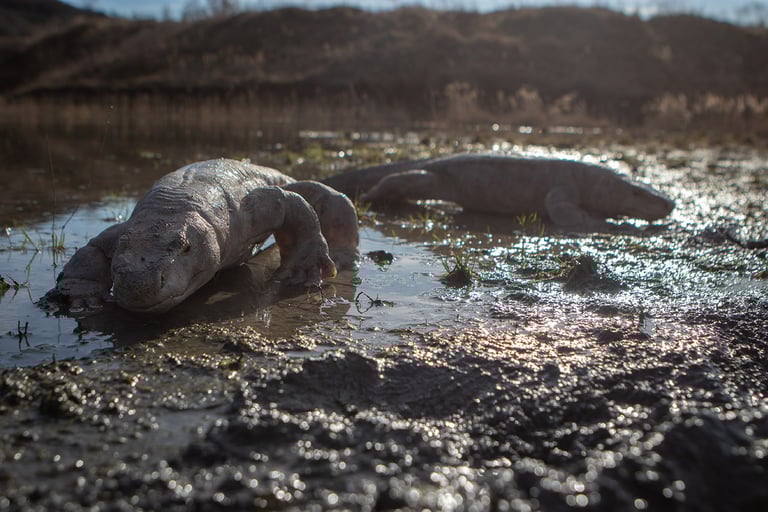


Orobates-, Eudibamus-, Bromacker-, Latimeria-, Diplocaulus-, Muschelkalk diorama made by Sebastian Brandt
View catalogue here.
From Field Research to a Finished Museum Diorama
An important part of my work is understanding the organisms and habitats that I reproduce. For an Arabian desert habitat diorama, field observations provided reference material for the reconstruction of characteristic desert vegetation, including Cistanche tubulosa and Cynomorium coccineum. Studying organisms in their natural environment provides information that isolated photographs cannot always communicate. Their growth forms, relationships to neighbouring plants, surrounding substrate and environmental conditions contribute to the character of the habitat. These observations inform the subsequent modelling and composition of the display.
Other projects require different approaches. A wet meadow diorama featuring marsh orchids must reflect the vegetation and environmental conditions of a moisture dependent habitat. A fungal diorama may reveal relationships that are usually concealed beneath the soil surface, including the association between fungal structures and their surroundings. In every case, the scientific subject determines the approach. There is no single composition or construction method that is appropriate for every ecosystem.


Rubroboletus satanas diorama made by Sebastian Brandt
View catalogue here.
What Makes a Successful Natural History Diorama?
A successful museum diorama is not defined solely by the realism of its individual components. It must communicate something meaningful about nature. The organisms should be scientifically recognisable. Their environment should be ecologically plausible. Their arrangement should reveal relationships rather than merely fill space. The design should encourage visitors to observe, investigate and discover. And the quality of the entire scene must remain consistent.
An exceptionally accurate animal model cannot compensate for an implausible habitat. Beautiful vegetation cannot compensate for an incorrect ecological interpretation. Every element contributes to the scientific and visual integrity of the whole. This is the principle that guides my work.
The Continuing Importance of Physical Dioramas
As museums increasingly incorporate digital technologies, physical dioramas continue to offer a distinctive form of scientific communication. They provide a tangible encounter with reconstructed nature. Visitors can explore spatial relationships directly, observe organisms from different perspectives and discover details through their own curiosity. For natural history museums, botanical gardens and scientific exhibitions, this creates opportunities to communicate biodiversity, ecological processes and the history of life through carefully researched physical displays.
The value of a diorama lies in how it encourages people to look more closely at the natural world. That is why dioramas matter.
About the autor:
Sebastian Brandt is the founder of Reco Brandt, a German workshop specialising in scientifically accurate biological models, botanical replicas, paleontological reconstructions and custom habitat dioramas for natural history museums and scientific exhibitions worldwide.
Download the Reco-Brandt catalogue here